From Extraction to Co-Production: Eldaniz Gusseinov Outlines Strategic Vision for Korea-Central Asia Relations

Nightingale Int. is proud to announce that our Head of Research, Eldaniz Gusseinov, delivered a speech at the Expert Forum “Enhancing the Korea-Central Asia Partnership: Shared Vision for the Future.”
Organized by the International Institute for Central Asia (IICA) and the Embassy of the Republic of Korea in Uzbekistan, the high-level forum brought together diplomats, scholars, and industry leaders to chart the course for the upcoming CA-Korea Summit in 2026.
Turning Trust into an Economic Engine
Addressing the audience, Eldaniz posed a central question for the future of the partnership: “How do we turn political trust into an economic engine that runs on its own, without needing constant diplomatic support?”
To answer this, he presented a strategic framework designed to move the region beyond traditional trade dynamics. Eldaniz argued that while Central Asia is emerging as a new global economic center, sustainable growth requires a decisive shift in how the region collaborates with technological powerhouses like Korea.
Three Pillars for a Resilient Partnership
Eldaniz outlined three core recommendations for the Korea-Central Asia Secretariat:
1. Transforming the Industrial Supply Chain: “From Extraction to Co-Production”
Eldaniz argued for moving beyond raw resource extraction toward integrated value-chain partnerships.
- Recommendation: Establish joint ventures for processing critical minerals, specifically Korean battery precursor plants and semiconductor component manufacturing within Central Asia.
- Goal: Secure Korea’s supply chains while facilitating vital technology transfer.
- Logistics: Leverage Korean AI and smart logistics expertise to optimize the Trans-Caspian International Transport Route.
2. Activating the Human Feedback Loop
To support industrial growth, the region needs a workforce trained to global standards.
- Recommendation: Expand beyond cultural exchange to create a robust system of Vocational Education and Training (VET) centers and “Dual-System” colleges.
- Goal: Create a “brain circulation” where local talent is trained to Korean industrial standards, supplying skilled labor for joint ventures in Central Asia.
3. Driving Institutional Innovation
Recognizing that business sometimes moves faster than diplomacy, Eldaniz proposed three mechanisms to streamline cooperation:
- Sector-Specific Task Forces: Private sector-led groups to solve operational bottlenecks.
- Consultative Board of Experts: To provide technical “reality checks” for policy.
- “Future Generation” Sounding Board: To integrate insights from young innovators in both regions.
Looking Toward 2026
The forum served as a critical platform for exchanging ideas ahead of the historic first CA-Korea summit scheduled for 2026. IICA Director Javlon Vakhabov noted that trade has grown 35-fold over the last three decades to $9 billion. Complementing this, the Ambassador of the Republic of Korea to Uzbekistan, Won Doyeon, emphasized the region’s enduring historical significance. He noted that Central Asia has long served as a bridge between civilizations along the Great Silk Road, a role that is now taking on renewed strategic importance.
Ambassador Won highlighted that the partnership is built on a “multi-level approach,” extending beyond politics to include parliaments, business, academia, and civil society. This comprehensive engagement aligns closely with the “new horizons” outlined by Eldaniz and his fellow experts.
Nightingale Int. thanks the organizers for fostering this vital dialogue.
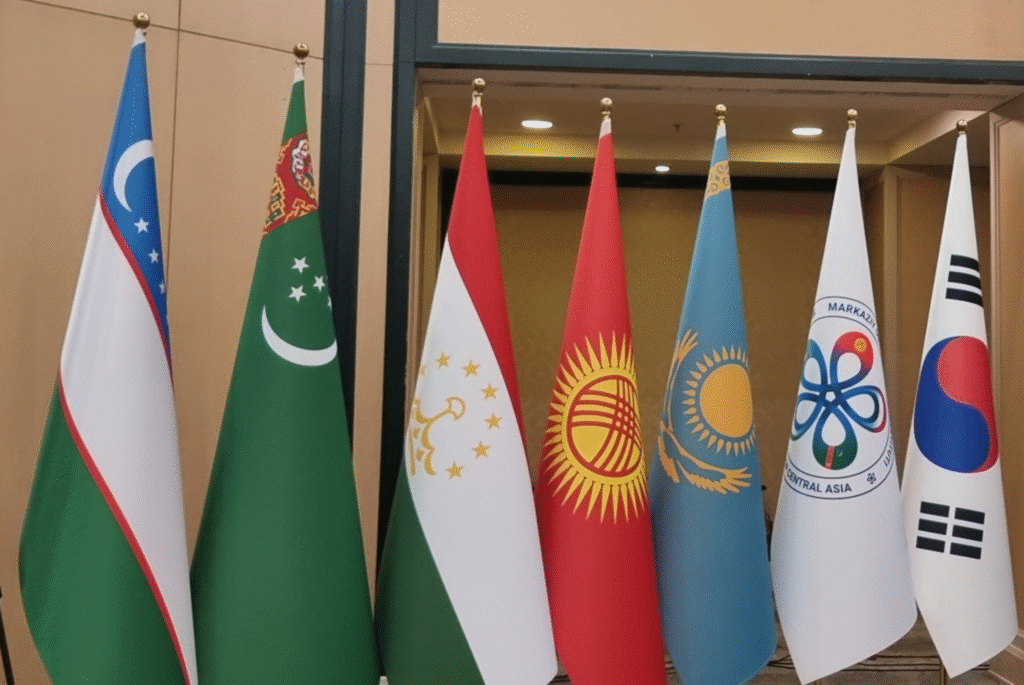
The national flags of the Central Asian states and the Republic of Korea stand alongside the flag of the International Institute for Central Asia (IICA), symbolizing the shared vision discussed at the Tashkent forum. Photo Credit: Eldaniz Gusseinov.