Japan provides over 40% of international aid to Central and South Asia

Japan’s Official Development Assistance (ODA) to Central Asian countries has become one of the most significant and strategically important donor initiatives in the region. Over the past twenty years, data from the OECD Development Assistance Committee (DAC) and Japan’s own reports show that Japan has emerged as the leading bilateral donor for Uzbekistan, Kazakhstan, the Kyrgyz Republic, and Tajikistan.
Its assistance combines large-scale concessional infrastructure financing with long-term technical cooperation, strengthening public administration, and close collaboration with the Asian Development Bank (ADB) and the World Bank. Together, these efforts create a unique donor image for Japan, focused on quality growth, climate resilience, and institutional development.
At the regional level, OECD data confirms that Japan is the largest bilateral donor in the broader South and Central Asian region, providing approximately $7 billion in 2023 alone—accounting for more than 40% of all bilateral Official Development Assistance (ODA) to this region. While these figures cover a wider geography, country-specific data shows that Central Asia holds a significant share of Japan’s developmental engagement.
Uzbekistan: Japan’s Strategic Partner
Uzbekistan has become the primary focus of Japan’s ODA in Central Asia, particularly since 2015. While aid volumes were modest and even declining in the early 2000s (from approximately $60 million in 2000 to less than $5 million in 2010), a sharp increase has been observed since 2015: roughly $116 million in 2015, $214 million in 2020, and a peak of nearly $284 million in 2021. After a slight dip in 2022, figures recovered to around $239 million in 2023.
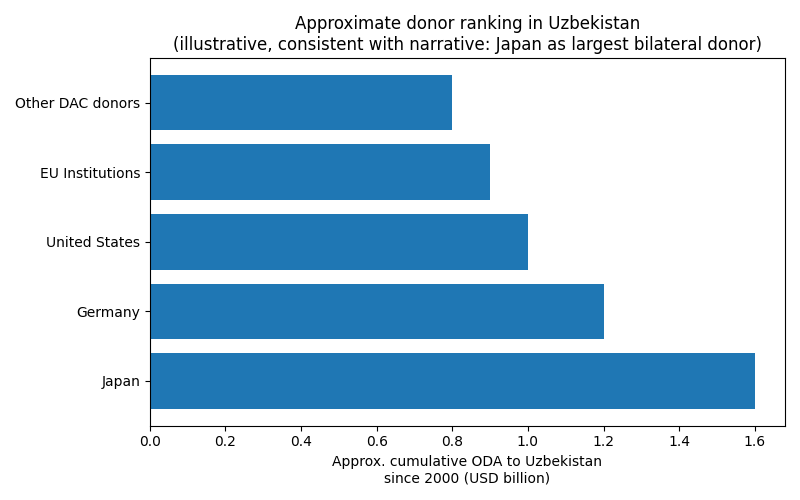
According to the data, Japan is Uzbekistan’s largest bilateral donor, providing cumulative aid of approximately $1.6 billion since 2000. This volume significantly exceeds that of other key partners, such as Germany and the United States, confirming Tokyo’s leading role in supporting the Uzbek economy.
This dynamic corresponds to the scale-up of infrastructure projects in energy, transport, and urban services financed by loans from the Japan International Cooperation Agency (JICA), as well as project preparation and policy support programs through the ADB and the World Bank. In practice, this means that in recent years, Uzbekistan has accounted for the majority of Japan’s net disbursements to the “Central Asian Five” (C5), and annual fluctuations in regional totals are largely driven by the disbursement cycles of major projects specifically in Uzbekistan.
In Uzbekistan, Japan has provided more than $1.6 billion in total ODA since Uzbekistan’s independence, and JICA’s project portfolio exceeds $3.7 billion, making Japan the leading bilateral investor and donor for infrastructure and public services.
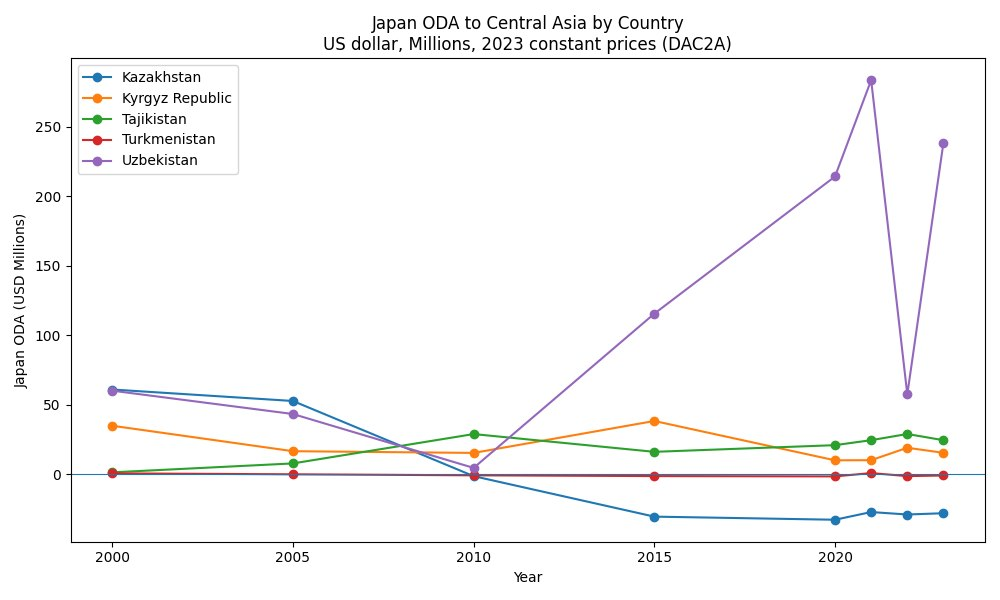
The chart clearly illustrates the sharp rise in Japanese aid to Uzbekistan after 2015, making it the absolute leader in terms of funds attracted in the region, with approximately $239 million in 2023. At the same time, figures for Kazakhstan moved into negative territory since 2010 due to repayments of previous loans, while financing volumes for Kyrgyzstan, Tajikistan, and Turkmenistan remain at a consistently low level.
Japanese ODA in Central Asia demonstrates divergent dynamics, driven by the level of economic development of the countries and the history of their interaction with Tokyo. While some states are in a phase of active borrowing growth, others have transitioned to a phase of repaying accumulated debt.
Tajikistan and Kyrgyzstan: Sustainable Growth and Social Stability
For these countries, which are eligible for International Development Association (IDA) resources, a positive dynamic is observed starting from the low base of the 2000s. Japan maintains steady, medium-scale engagement here, focused on strengthening state capacity and sustainable development:
- The Kyrgyz Republic received approximately
600–600–700 million over the entire period. Annual volumes range from $15 to $40 million (with peaks in 2015 and 2023). Main priorities include disaster risk reduction (DRR), rural water supply, transport connectivity, and governance reform. - Tajikistan demonstrated growth from almost zero at the beginning of the century to
25–25–30 million per year by 2022–23. The total volume of aid amounted to500–500–600 million. Support is focused on hydropower rehabilitation, irrigation, road networks, and seismic resilience.
Kazakhstan and Turkmenistan: Cycle Completion and Selectivity
In these countries, net flows are negligible or even negative, which is related to their specific economic status:
- Kazakhstan is the largest recipient of aid in historical perspective—since the early 2000s, the ODA volume has totaled about $1 billion. However, while disbursements reached
50–50–60 million in 2000–2005, net flows have been negative since 2010. This means that repayment amounts for old yen loans currently exceed new inflows. Nonetheless, Japan continues to support transport modernization, environmental management, digital governance, and SME development. - Turkmenistan shows the most modest figures—roughly
100–100–150 million in total. Interaction is targeted and highly selective (energy efficiency, technical cooperation), and net annual flows fluctuate around zero.
Japan’s approach in the region represents a balanced strategy. Work in Tajikistan and Kyrgyzstan, aimed at resilience and logistics, complements Japan’s massive infrastructure push in Uzbekistan. Overall, Japanese ODA in Central Asia has evolved from massive infrastructure lending in the most developed economies toward long-term partnerships in governance, security, and regional connectivity.
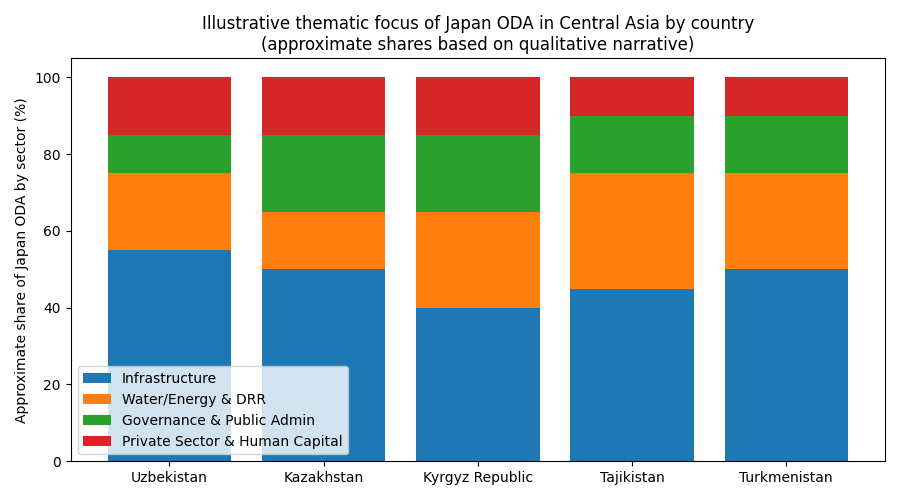
The chart demonstrates that infrastructure development is the dominant direction of Japanese ODA in all five countries of the region, accounting for 40% to 55% of the total aid volume. At the same time, Tajikistan and the Kyrgyz Republic show the highest share of projects in the fields of water resources, energy, and disaster risk reduction (DRR) compared to their neighbors.
Infrastructure as a Priority for Japan’s Concessional Financing
Japan’s strategic priorities in the region emphasize quality, sustainability, and institutional strengthening. Its concessional loans finance railways, metro systems, power generation, energy efficiency programs, urban water supply, and municipal transport, providing long-term capital investments that few other bilateral donors are capable of supporting.
Japan’s role in strengthening water and energy security is particularly visible in Tajikistan and the Kyrgyz Republic, where hydropower assets, irrigation systems, and disaster risk management structures benefit from sustained Japanese involvement. Public administration reform is another central pillar: through technical cooperation programs and advisory support, Japan facilitates the training of civil servants, modernization of statistics, digital government transformation, budget management, and regulatory reform.
Japan is a Key Contributor via International Organizations and Development Banks
Japanese assistance is also aimed at strengthening the private sector and human capital. Japan Centers in Uzbekistan, Kazakhstan, and the Kyrgyz Republic provide management training, entrepreneurship development, and consulting services for SMEs. These initiatives complement broader World Bank and ADB programs to improve the investment climate and promote economic diversification.
Implementation mechanisms further distinguish Japan’s role. JICA ODA loans finance major infrastructure on highly concessional terms with long repayment periods. Technical cooperation forms the core of Japan’s support for governance and capacity building, while targeted grants fund social development, healthcare, education, and community-level resilience.
An important tool for implementing this strategy is Japan’s work through trust funds managed by multilateral development banks (MDBs). This allows Tokyo to systematically influence key areas:
- Resilience and Agriculture: Through the Japan Fund for Prosperous and Resilient Asia and the Pacific (JFPR), which supports food security and protection against natural disasters.
- Infrastructure and PPP: The Asia-Pacific Project Preparation Facility (AP3F) helps the ADB prepare large-scale infrastructure and public-private partnership projects.
- Human Capital: Contributions to the World Bank (PHRD and JSDF funds) are directed toward civil servant training and local community development.
- Standards in Kazakhstan and Uzbekistan: The “Quality Infrastructure Investment” (QII) partnership introduces high governance standards in the region’s largest economies.
In aggregate, Japanese development assistance represents one of the most durable and significant long-term engagements in Central Asia. Compared to other OECD donors, Japan provides higher volumes of infrastructure-oriented financing, is more deeply involved in creating climate-resilient systems and disaster risk reduction, and provides broader support for institutional capacity building.
Its close coordination with the World Bank and ADB amplifies the impact of its bilateral programs and strengthens its ability to influence the trajectory of economic modernization, regional connectivity, and sustainable growth across all of Central Asia.
Russian version of the article was published by Cronos.asia.
