The Triple Threat: How China Perceives the Japan–Central Asia Summit
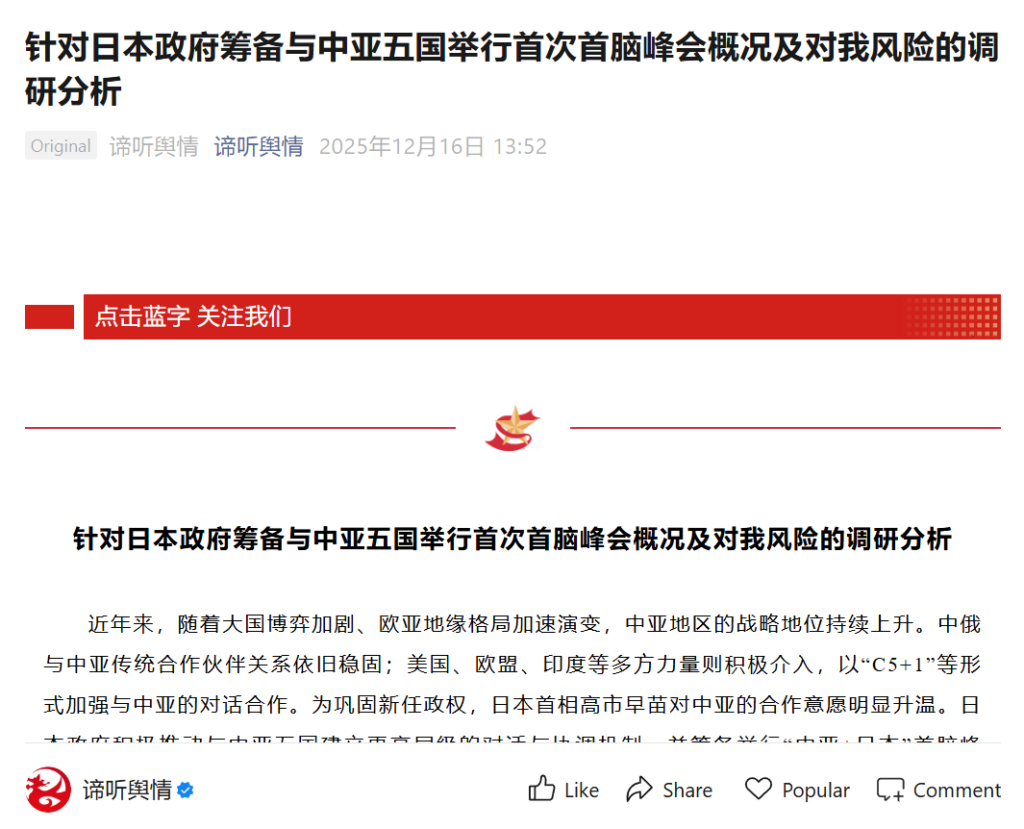
China will perceive the first Japan–Central Asia summit in Tokyo as a nexus of three threats: an attempt to bypass the PRC politically and regarding resources in the region, a strengthening of the anti-Chinese belt of U.S. allies, and the creation of yet another channel for discussing Taiwan and security without Beijing’s participation. Against this backdrop, Beijing views Japanese activism not only as competition for tungsten, rare earth elements, and copper, but also as an element of a broader economic security strategy of the U.S. and its allies in Eurasia.
As Chinese experts emphasize in conversations with Nightingale Int., in the short term, Beijing will attempt to react to Japanese activity in Central Asia through neutral formulas and publicly avoid direct confrontation so as not to push the countries of the region toward demonstrative diversification.
But as the format becomes institutionalized and the stakes regarding critical resources rise, the Japanese line is increasingly clearly perceived as part of a strategy to weaken China’s advantages in the sphere of key minerals and restructure global supply chains.
For China, this implies a need to simultaneously maintain economic leadership in the region and seek ways to limit the influence of Japanese soft power like aid programs, training, and institutional building, which, as Chinese researchers themselves admit, form long-term networks among Central Asian elites and intensify competitive pressure on Beijing.
Chinese perception of the summit is influenced by the situation around Taiwan
In the autumn of 2025, relations between Beijing and Tokyo entered a phase of acute confrontation following a statement by Japanese Prime Minister Sanae Takaichi that a military scenario around Taiwan would be a “threat to Japan’s survival” and could require invoking the right to collective self-defense.
China responded with harsh rhetoric, the summoning of the ambassador, warnings about destructive military consequences of Tokyo’s potential interference, and an expansion of economic pressure, import restrictions, and tourist and business warnings.
Against this backdrop, any step by Japan to build new security and economic cooperation formats in Eurasia, including the “Central Asia plus Japan” summit on December 19–20 in Tokyo, is automatically perceived in Beijing through the prism of Taiwan and the containment of China.
China sees an attempt to weaken Beijing’s resource leverage over global high-tech supply chains
For China, Central Asia has been a rear strategic perimeter and a key land corridor for the Belt and Road Initiative, as well as a transcontinental source of energy resources, raw materials, and uranium for over a decade. The PRC’s trade with the five Central Asian states reached approximately $95 billion in 2024, which is nearly three times the 2014 level, and China’s share in the region’s foreign trade has grown to 24%.
The fact that Tokyo is elevating the “Central Asia plus Japan” format to the level of the first-ever leaders’ summit, and at a moment of a fierce dispute over Taiwan, will be read in Beijing as an attempt to strengthen an alternative, pro-Western contour of economic and normative dependence in the region.
Japan’s emphasis on economic security, the development of transport corridors bypassing Russia and, indirectly, China, and access to critical resources (tungsten, rare earths, copper) will be interpreted as an attempt to weaken Beijing’s resource leverage over global supply chains for high technologies.
Logistics and resources form the concern in China’s perception
The Japanese government directly links the summit to the task of ensuring access to critically important minerals. Tokyo has scheduled discussions with the leaders of Kazakhstan, Uzbekistan, Kyrgyzstan, Tajikistan, and Turkmenistan on developing supply chains for rare earth metals and uranium, as well as cooperation in the mining and processing of tungsten and copper.
From the PRC’s point of view, Japanese resource realism in Central Asia hits two of China’s vulnerabilities at once. First, it involves competition for control over the extraction and export of strategic minerals, where China strives to maintain technological and processing superiority and a significant share of the global market.
Second, the logistics projects discussed in Tokyo like support for routes bypassing Russia and potential docking with corridors supported by the EU, Turkey, and the U.S., form a contour of land-based Eurasia for Beijing where China is not the sole system-forming center of infrastructure and norms.
In the logic of Chinese strategists, this fits into the general picture of an “economic NATO”: a network of partnerships that, without being formal alliances, create a dense belt of infrastructural and resource dependence on the U.S.-Japan-EU bloc.
The role of Russia and the rhetoric of “foreign interference”
Moscow has already used negative rhetoric, criticizing Japan’s meetings with Central Asian ministers: Russian Foreign Ministry spokesperson Maria Zakharova stated in 2022 that such formats are aimed at “reformatting traditional economic ties” of the region and “dragging it into an anti-Russian and anti-Chinese agenda.”
For China, this rhetoric is convenient: the argument that Tokyo is acting in concert with its allies and expanding a rules-based order with an anti-Russian and anti-Chinese bias is easily transferred to the current summit.
Likely, Chinese media will conceptually repeat Russian formulations, emphasizing Japan’s geographic distance from the region, suspecting Tokyo of attempting to limit Central Asia’s cooperation with traditional partners, and linking Japan’s economic initiatives with the U.S. military-political line in the Indo-Pacific region.
Japan places emphasis on the periphery of the Chinese sphere of influence
How Tokyo acts in Central Asia is not unique; it is part of a broader strategy of presence on the periphery of China’s sphere of influence. In Mongolia, Japan has become one of the key donors over the past two decades, financing infrastructure, energy, and social sectors while parallelly supporting the transition to democracy, the strengthening of macroeconomic management, and administrative reforms.
In Southeast Asia, primarily in Vietnam, Indonesia, the Philippines, and Malaysia, Tokyo promotes the concept of quality infrastructure and acts as an alternative to Chinese loans and contractors, linking investments in ports, railways, and energy with the agenda of a Free and Open Indo-Pacific. In relations with India, Japanese projects in industrial and transport corridors are also embedded in a joint discourse with New Delhi and Washington on containing China, albeit without direct military alliances.
Against this backdrop, Central Asia logically becomes another node of the same logic: where China dominates in raw materials and infrastructure, Japan tries to enter as a high-quality alternative partner, offering technologies, institutional expertise, and long-term projects.
As Chinese experts note, the “Central Asia plus Japan” format, launched back in 2004 as a technocratic dialogue between foreign ministries and line ministers, long remained in the shadows without leaders’ summits and without a serious geopolitical load. The transition to a summit at the highest level in 2025 shows that for Tokyo, Central Asia is ceasing to be a secondary direction for humanitarian aid and is turning into an instrument of a strategy to contain China through its immediate neighborhood.
Without good relations with China, Japan’s influence may be limited
China retains structural advantages in Central Asia that constrain Tokyo’s maneuvers. China provides up to 60% of imports for a number of countries in the region and remains the largest trading partner of Kazakhstan and Kyrgyzstan; in 2024, Chinese-Kazakh trade turnover exceeded $43 billion, and trade with Kyrgyzstan exceeded $22 billion.
Japanese presence, by contrast, is relatively modest: Japan’s total trade with the five Central Asian states is measured in single-digit billions, with Japanese ODA and infrastructure loans making Tokyo a qualitative rather than a quantitative player.
Beijing’s centripetal pressure through energy, transit, migration, and participation in regional formats (SCO, CICA) means that Central Asian capitals will have to balance, using Japanese capital and technologies for diversification, but avoiding steps that Beijing would read as a frontal accession to an anti-Chinese coalition.
Therefore, the region’s states will, in all likelihood, use the summit in Tokyo to diversify partners and gain access to Japanese technologies and finance, but will try not to cross Beijing’s red lines—primarily, not linking the format to Taiwan issues and the military-political containment of the PRC.
How the Japan–Central Asia format might develop
Based on existing experience and the logic of Japanese policy regarding China, several directions for the development of the format can be expected:
- Institutionalization: If the first summit passes without disruptions, Tokyo will likely propose making leaders’ meetings regular (once every two or three years), with inter-sessional work by specialized groups on critical minerals, logistics, and digital infrastructure.
- Deepening niche specialization: Japan will promote a “minerals in exchange for technologies” nexus. This includes AI solutions and high-precision equipment for exploration and processing of raw materials, the digitalization of transport corridors, and training programs for management and technical elites.
- Strengthening the link with American strategy: Japanese initiatives in Central Asia will be increasingly closely linked to U.S. frameworks on critical minerals and economic security, turning Tokyo into a sort of quiet operator of the American agenda in the region.
Against the backdrop of the Russo-Ukrainian war and tensions around Taiwan, part of the Japanese establishment is becoming more active in Central Asia, and Tokyo’s actions in the region can no longer be viewed as neutral toward China. Japan, on the one hand, remains a country seeking rich resources, for which Central Asia is a natural direction for the diversification of its raw material base and the strengthening of its own economic security.
On the other hand, due to the growing rivalry with Beijing, Japanese activity here is increasingly clearly turning into an element of a geopolitical game. While not competing with China in the scale of trade and investment, Tokyo makes a bet on soft power, technologies, and institutional influence, precisely what China perceives in the long run as the most dangerous challenge.
