Don’t Wait for the West: A New Strategy for Central Asian Critical Minerals
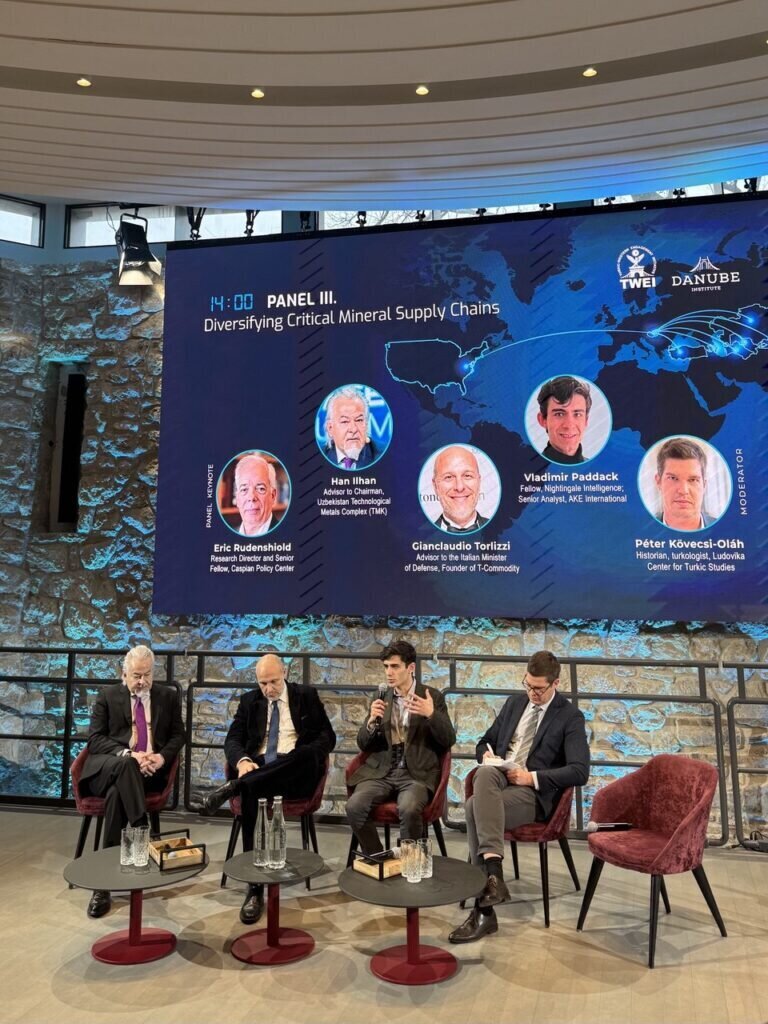
Nightingale Fellow Vlad Paddack highlighted key lessons from discussions on advancing Western critical minerals cooperation with Central Asia at the Danube Institute’s Inaugural Turkic–Western Geopolitical Dialogue.
1. Taking the Lead
At Nightingale Int., we believe the US and EU could help build full production chains rather than simply extracting raw materials, boost the region’s growing manufacturing base and leverage its growing pool of talent. However, Central Asian governments and firms should not wait for US and European demand to materialise on its own. Western policymakers, preoccupied with domestic agendas and short-term crises, need consistent reminders of the region’s strategic relevance. More importantly, they need concrete, investable propositions. It is such specificity, not abstract appeals to geostrategy, that compels Western firms to act.
2. Leveraging Public Capital
There is no shortage of private capital in the US and Europe for financing projects in Central Asia. Investors hesitate because of perceived risks – regulatory unpredictability, geopolitical exposure, infrastructure bottlenecks and skills gaps – and insufficient incentives.
Leveraging Western public capital is therefore vital absorb the risks that private investors cannot, allowing private capital to focus on commercial risk. Ultimately, unlocking private investment in Central Asia is not a question of market failure, but of Western policy design: whether the US and Europe are willing to deploy public instruments that shift incentives and make Central Asia a commercially rational choice for firms that otherwise would not enter.
3. Western Policy Options
Deploying guarantees, co-financing and offtake-backed instruments make midstream localisation commercially rational for investors who would otherwise avoid the frontier risk. Public financing can be paired with support for regulatory transparency, formulating Central Asia’s own ESG standards that meet its requirements, and producing reliable geological data – such as through a Regional Critical Minerals Observatory.
Western governments can draw on their strength in education by expanding scholarships, technical training, visa facilitation and university exchanges that build the skilled workforce required for processing and advanced manufacturing. Building midstream capacity also makes trade more efficient by transforming bulky raw ore into higher-value, compact refined materials that are more profitable to export.
4. Consulting End-Users
A major issue is the role of end users. Supply chains from mine to advanced technology are complex and opaque, and many end users lack visibility into mid-tier suppliers or upstream vulnerabilities. Their silence may reflect structural incentives rather than indifference: policymakers focus on long-term risks, while corporate leaders face quarterly scrutiny.
A CEO who raises medium-term supply chain fragility risks triggering the reaction he seeks to avoid: shareholder dissatisfaction, capital flight and a declining share price. Without involving end users, discussions of supply chain resilience risk becoming detached from commercial realities.
5. US-EU Competition
Moreover, the competitive dynamic between the United States and the European Union presents a narrow but significant opportunity. Over the next three years, under a second Trump administration, the rivalry between Washington and Brussels is intensifying, creating a window in which Central Asia can leverage the competition to secure greater attention and better terms. But this requires clarity on what the region actually seeks from each partner.
If the EU lacks the instruments or political will to provide substantial financing, then expectations should be adjusted. Ultimately, it will be European companies and investors – not EU institutions – that drive meaningful engagement, provided they are met with credible proposals that balance commercial viability with strategic opportunity.
Here is a quote from Vlad’s personal reflection on his visit to Budapest, which he shared on LinkedIn:
Personal reflections from our fascinating discussion on how to deepen Western ties with Turkic states at the Danube Institute in Budapest:
I arrived with proposals to align Western strengths with Central Asia’s ambition to build a just development model. As I think my colleagues in Central Asia would agree, the US and EU could help build full production chains rather than simply extracting raw materials, and boost the region’s growing manufacturing base. More importantly, Central Asia has an immense pool of talented people with unmatched entrepreneurial spirit and ambition.
But I found myself asking how much the US and EU states truly have to offer Central Asia compared to what the region offers them. How serious are these governments about becoming active players? As I wrote in my key lessons for Nightingale Int. (link in comments), Central Asia cannot wait for policymakers from the US and EU, who need consistent reminders of the region’s strategic relevance, and above all, concrete, investable propositions.
Still, while China, Russia and Turkey actively court Central Asia, the West has hesitated. As Ambassador Richard E. Hoagland argued, international relations are often shaped by strong interpersonal ties. Cultural differences have historically limited these ties: the West’s focus on individual liberties, rules-based systems and a tendency to bureaucratise governance sit uneasily with a region where ties are bound by respect for authority and informal relationships. The current return to Realpolitik has opened space for pragmatic cooperation, but how long will this moment last?
Another question is whether Western engagement is driven by geopolitics, economics, or both, and what that means for approaching Western partners. Europe has an urgent economic rationale for integration with Central Asia, driven by diversification away from Russian energy and trade routes. But the EU lacks a coherent, unified strategy; some would even question its relevance in this context. Why not directly approach those European states and firms that understand the urgency of engaging with the region?
And if entry of American and European investments is driven only by economic rationale, what commitments can we expect from firms acting on commercial logic? If the West has serious geopolitical ambitions, it must recognise what it takes to match China’s role: as I noted, China has already localised EV production in Uzbekistan. Can companies from the US and EU offer as much, given their reluctance to transfer sensitive technology? Either way, meaningful Western engagement would require major policy shifts to create stronger incentives for investment in Central Asia.
These are not easy questions, and momentum could still shift towards greater Western political engagement with Central Asia. In the meantime, as my fellow discussant Han ilhan would have said, let’s move away from talk of “strategy” to tactical plans for attracting American and European investment in the region.
We are proud to see our experts shaping critical conversations on Western-Turkic cooperation, supply chain resilience, and the future architecture of integration across Eurasia.