Azerbaijan’s Central Asia Ambitions Stalled by Weak Rules
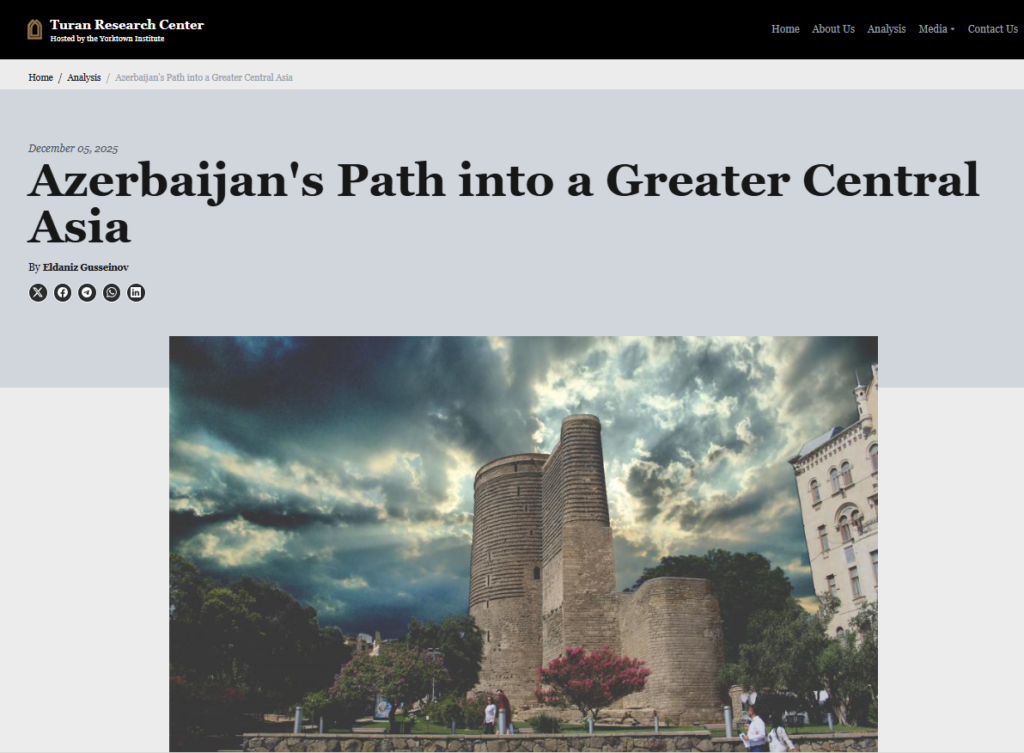
The deepening cooperation between Azerbaijan and Central Asia represents one of the most significant—albeit under-examined—trends in Eurasian geopolitics.
Ultimately, the impact of this trend will be measured not merely by Azerbaijan’s presence at the Consultative Meetings of Central Asian Leaders, but by its capacity to shape the agenda, participate in the drafting of strategic documents, and embed itself within the emerging regulatory and legal framework.
Should these processes continue apace, Azerbaijan could, de jure, become a permanent stakeholder in agreements that have traditionally bound only the Central Asian quintet.
This is the subject of an article “Azerbaijan’s Path into a Greater Central Asia” written for the U.S.-based Turan Research Center by Eldaniz Gusseinov, Head of Research at Nightingale Int.
The key logic behind Azerbaijan’s participation in Central Asian processes rests on three factors:
1. The Security Sphere: Azerbaijan is one of the few countries to conduct large-scale military exercises (“Birlestik”) with four Central Asian states outside the frameworks of the CIS or SCO. Cooperation in military intelligence and counterterrorism is forming a shared security space that complements economic ties.
2. The Chinese Vector: For Beijing, the consolidation of a “C6” format simplifies the regulation of transit to Europe (the Belt and Road Initiative), making the South Caucasus and Central Asia a pivotal link.
3. European Interest: The EU’s Global Gateway strategy and access to Central Asian resources are impossible without Baku’s participation. Azerbaijan is becoming an indispensable node connecting the region to the West.
Despite the growth in military and economic cooperation, a number of structural obstacles to full integration remain:
1. A Weak Legal Framework: Decisions adopted at consultative meetings may lack legal binding force, or not all five Central Asian countries may accede to them. This creates a gap between political intent and actual institutional commitments.
2. External Recognition Issues: Even if the region de facto functions as a “C6”, external formats (such as the U.S. “C5+1” platform) may continue to exclude Azerbaijan, thereby preserving the region’s traditional boundaries.
3. Institutional Heterogeneity: The region lacks a single market, a common customs space, or a unified investment regime. Divergent external orientations among the states (WTO membership, EAEU affiliation, or policies of neutrality) complicate the creation of a unified regulatory base.
Conclusion: Azerbaijan’s future within a “Greater Central Asia” depends on its ability to convert functional cooperation into institutional reality and on the willingness of external actors to revise their approaches to the region’s architecture.
About the Turan Research Center
The Turan Research Center is a non-partisan initiative hosted by the Yorktown Institute dedicated to modern-day developments in the Turkic and Persian worlds—the historic Turan region and beyond.