Strengthening Strategic Connectivity and Security: Insights from the “India and Kazakhstan” Forum in Almaty
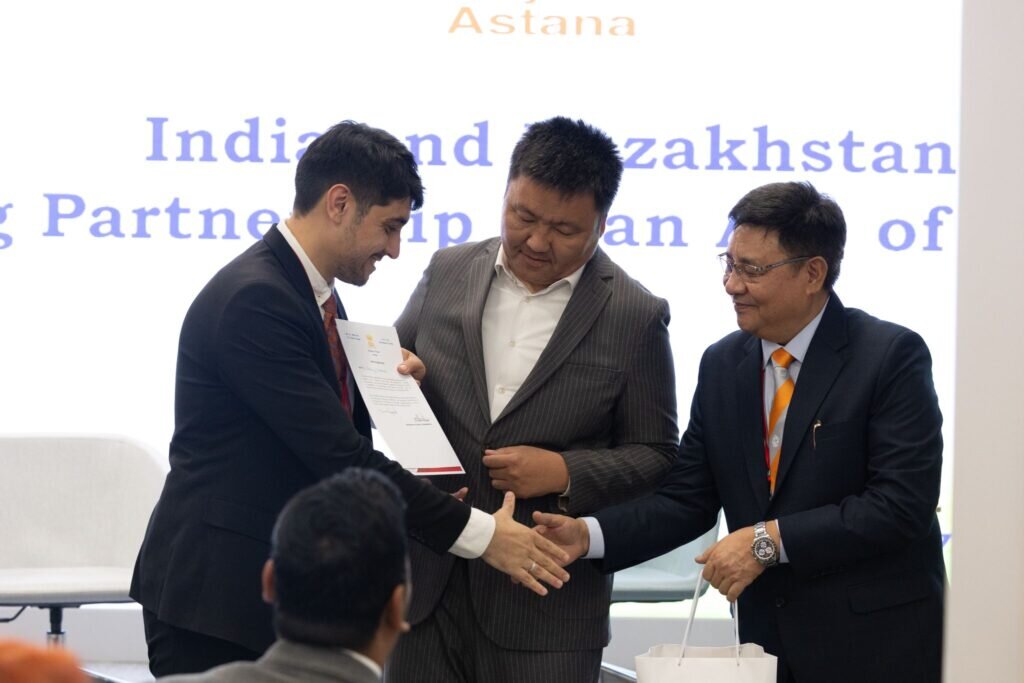
On November 13, participating in the high-level international forum “India and Kazakhstan: Forging Partnership in an Age of Disruption” in Almaty, Eldaniz Gusseinov addressed the critical need for deeper cooperation between New Delhi and Astana. Co-organized by the Embassy of India in Kazakhstan, Narxoz University, the HeartLand Expert-Analytical Center, and the Project Center for Social Transformations & Spatial Development, the event gathered diplomats and scholars to navigate evolving geopolitical challenges.
In the address, the focus was placed on the intersection of economic connectivity and regional security. With India expanding trade via the International North-South Transport Corridor (INSTC) and Chabahar Port, the sustainability of these routes relies heavily on joint risk monitoring. The intervention proposed specific mechanisms – including shared analytical tools and strategic information-sharing agreements – to protect these vital supply chains from disruptions and terrorism-related threats.
Read the full remarks on regional connectivity and counter-terrorism cooperation below:
“On November 13, I participated in the international forum “India and Kazakhstan: Forging Partnership in an Age of Disruption” held in Almaty and co-organized by the Embassy of India in Kazakhstan, Narxoz University, the Expert-Analytical Center HeartLand, and the Project Center for Social Transformations & Spatial Development.
The event brought together diplomats, scholars, and practitioners to discuss how India and Kazakhstan can strengthen cooperation amid rapidly evolving geopolitical and economic challenges.
In my remarks, I emphasized that Kazakhstan and India must deepen information exchange related to regional connectivity projects, particularly those passing through Afghanistan and Iran. The sustainability of emerging transport corridors depends on the ability of both countries to jointly monitor risks, anticipate disruptions, and adapt routes in real time. I proposed three practical mechanisms:
- the creation of a joint risk data set for connectivity projects;
- the establishment of strategic information-sharing agreements;
- the development of shared analytical and forecasting tools that help adjust transport routes when needed.
India is expanding its trade with Central Asian states, driven by high-value sectors such as pharmaceuticals, machinery, and vehicles. To secure and scale this growth, New Delhi is strengthening alternative transport routes through Iran and western Afghanistan, using the Chabahar Port, the INSTC, and the Kazakhstan–Turkmenistan–Afghanistan corridor to ensure reliable overland access to Central Asia.
A significant part of my intervention focused on terrorism-related threats, including the activities of extremist groups whose operations endanger not only regional security but also the economic interests of both India and Kazakhstan.
Coordinated forecasting and information sharing can reduce the scale of economic losses that result from geopolitical shocks.
In this context, I noted that India has developed a comprehensive, multi-layered counter-terrorism approach. It includes enhanced inter-agency coordination, extensive use of technology from cyber surveillance to advanced border infrastructure, and strong legal foundations aligned with the UN Charter. India’s approach also prioritizes preventive frameworks, community resilience, and rights-based counter-radicalization.
India and Kazakhstan already maintain an active dialogue through the Joint Working Group on Counter Terrorism, which last convened in April 2024 in Astana. The two sides regularly exchange assessments on state-sponsored and cross-border terrorism, terror financing, misuse of modern technologies, and radicalization trends.
Cooperation continues to expand through capacity-building programs, joint training, and coordination in multilateral platforms including the United Nations, the Shanghai Cooperation Organization, and the Egmont Group.”